Paul Schembri
Man on FirePaul Schembri is a farmer on Gozo and the quiet center of a household that gives Creasy shelter after he arrives in Naples exhausted and unable to find a reason to keep living. Paul’s importance lies less in speeches than in the forms of welcome he offers: an unceremonious greeting, a room made available, and hard work that Creasy can share. His farm becomes a place where recovery is practical, communal, and built one stone at a time.
Identity and Character
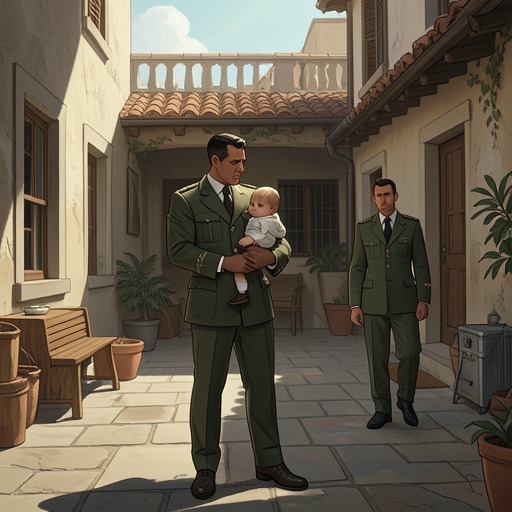
Paul’s values are rooted in hard work and the productive cycle of farming. He keeps his counsel rather than displaying his opinions, and his financial independence matters to his bearing: he has money in the bank and can look any man in the eye. The description compares him to the dry-stone walls around his fields—dusty, carefully made, each stone fitted against another without mortar, yet strong enough to withstand the Gregale winds that scour the low hills in winter. The comparison captures both his reserve and his resilience without making him remote. His strength is understated, like the work of construction itself.
He is physically smaller than his wife, Laura, and initially appears thin, but Creasy notices the sinewy, corded strength in his arms and the compactness of his build. Paul’s plain greeting to Creasy, “Alright?”, carries the everyday flexibility of a widely used Maltese word, which can function as question, statement, greeting, or farewell. Creasy answers, “Alright,” and Paul sits down with the coffee Laura has made. The exchange is brief, but its ease matters: Paul receives Creasy without requiring a formal explanation or treating him as a stranger who must earn entry into the room.
Household and Welcome
Paul is Laura’s husband and Joey’s father, and their home is a working family household rather than a setting reserved for ceremony. The large arched room Creasy remembers is where family life gathers; the dining room and lounge are used only on formal occasions. Laura busies herself with coffee and cooking, while Paul comes in from the fields and takes his place among them. Their welcome is quietly reinforced by ordinary domestic actions, not by declarations. Creasy realizes that he is inside a family unit, yet does not feel uneasy: his presence is accepted without fuss.
The practical arrangements extend that welcome. The family gives Creasy a small suite in the newer wing, with a separate entrance by an outside staircase. The rooms had once been storage space and a hay loft; now they provide him privacy while keeping him within the household. Paul explains that Guido Arrellio has sent money every year since marrying Julia, and continued after her death. Paul had initially been angry because the family was not poor and had threatened to return it. Guido disarmed the objection by saying the money was for tax reasons. The detail shows that Paul is not simply a passive recipient of help: he has his own means and pride, and accepting assistance requires an explanation that preserves his dignity.
Shared Work and Creasy’s Recovery
Guido recommends Gozo as a base because he knows Creasy will receive a warm but undemonstrative welcome from the Schembris. He has also explained Creasy’s condition and recent events to Paul, though not what the future will hold. The family has recently rented fallow fields from the church, and the work of reterracing and preparing them is strenuous. Paul’s farm therefore offers something more substantial than shelter: it gives Creasy useful labor suited to the recovery he needs.
After breakfast, Creasy goes into the fields, finds Paul, takes off his shirt, and works beside him on a dry-stone wall. Paul is surprised by how quickly Creasy learns the craft, though Creasy has a natural eye for the placement of the rocks. The work exacts an immediate physical cost: after an hour, Creasy’s back aches from bending, and his long-softened hands are scratched and blistered. Paul calls a halt at noon. Creasy bathes his hands in seawater, eats lunch with the family, and sleeps through the heat of the afternoon in the cool stone house. Though stiff and bruised, he returns to the terraces at three and resumes working alongside Paul. Their progress is made in silence, with the shared task allowing companionship without requiring intimate conversation.
Reciprocity and Significance
Paul’s welcome does not erase the question of obligation. After living in the house for more than two months and eating what he calls a mountain of food, Creasy takes Paul aside and says that he owes him money. Paul looks surprised and asks, “For what?” Creasy insists that his stay and meals have a cost. The exchange brings their relationship into focus: Paul has offered room, food, and work as part of his household’s hospitality, while Creasy tries to answer that generosity in concrete terms rather than accept it as limitless charity.
Paul’s role is consequential precisely because it is undramatic. Creasy arrives burdened by despair and diminished physical condition; at Paul’s farm, he is welcomed, fed, and put to work on land whose improvement requires patience and repeated effort. Paul does not claim to cure him or press him to explain his future. Instead, the household’s steady routines and the demanding craft of building walls give Creasy a place to regain strength. Paul’s reserve is not a lack of care: it is the manner in which care takes shape in this family, through practical provision, shared labor, and respect for another man’s independence.